Atiya Begum Fyzee
Challenging Purdah: Public Presence and Political Voice
In 1926, at the Muslim Educational Conference in Aligarh, a woman walked onto the dais unveiled and addressed the audience directly. At a time when most elite Muslim women in North India still observed purdah and rarely appeared in public political gatherings, her gesture was startling. Senior leaders protested, insisting she withdraw. She refused. Instead, she, alongside other women, delivered a speech demanding that Muslim women have the same right as men "to go about on God's earth freely and openly." The woman was Atiya Fyzee.
Born in Istanbul in 1877 into the prominent Tyabji family of Bombay, Atiya belonged to a generation experimenting with new forms of Muslim modernity. She travelled widely, studied in London, and recorded her experiences in the Urdu diary Zamana-i-Tahsil, offering a rare account of a young South Asian Muslim woman navigating imperial Europe. She wrote for reformist journals and maintained close intellectual exchanges with leading thinkers of her time, including Shibli Nomani and Muhammad Iqbal.
Cultural Intermediary: Marriage, Music, and Global Exchange
In 1912, she married the Indian Jewish artist Samuel Rahamin, who converted to Islam and took the name Samuel Fyzee Rahamin. Together they became important cultural intermediaries. She would go on to produce influential work on Indian classical music that introduced global audiences to its traditions. After Partition, at Muhammad Ali Jinnah's invitation, the couple moved to Karachi, where their home became a gathering place for artists, writers, and musicians.
Displacement and Marginalization: A New Pakistan's Limits
Yet the Pakistan that emerged proved less hospitable to the cosmopolitan world Atiya had embodied. Religious conservatives attacked her independence and public presence; within a few years, the couple were evicted from their home, and Atiya spent her final years in poverty, largely forgotten by the society she had helped shape.
Recovering a Plural Vision
Atiya Fyzee's life reminds us that South Asia once contained a vibrant, plural vision of Muslim modernity, one in which women claimed intellectual authority, public presence, and freedom of movement. Recovering her voice today is more than historical reclamation; it highlights how the struggles she spoke about in Aligarh, over women's visibility, autonomy, and the right to inhabit public space, remain unfinished and urgently relevant.
Atiya Begum Fyzee
2 March, 1973 · 1 recording
1965 Interview
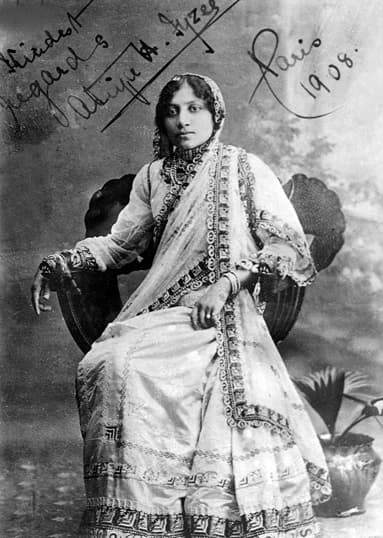
Atiya Begum Fyzee
In 1926, at the Muslim Educational Conference in Aligarh, a woman walked onto the dais unveiled and addressed the audience directly. At a time when most elite Muslim women in North India still observed purdah and rarely appeared in public political gatherings, her gesture was startling. Senior leaders protested, insisting she withdraw. She refused. Instead, she, alongside other women, delivered a speech demanding that Muslim women have the same right as men "to go about on God's earth freely and openly." The woman was Atiya Fyzee.
Born in Istanbul in 1877 into the prominent Tyabji family of Bombay, Atiya belonged to a generation experimenting with new forms of Muslim modernity. She travelled widely, studied in London, and recorded her experiences in the Urdu diary Zamana-i-Tahsil, offering a rare account of a young South Asian Muslim woman navigating imperial Europe. She wrote for reformist journals and maintained close intellectual exchanges with leading thinkers of her time, including Shibli Nomani and Muhammad Iqbal.
In 1912, she married the Indian Jewish artist Samuel Rahamin, who converted to Islam and took the name Samuel Fyzee Rahamin. Together they became important cultural intermediaries. She would go on to produce influential work on Indian classical music that introduced global audiences to its traditions. After Partition, at Muhammad Ali Jinnah's invitation, the couple moved to Karachi, where their home became a gathering place for artists, writers, and musicians.
Yet the Pakistan that emerged proved less hospitable to the cosmopolitan world Atiya had embodied. Religious conservatives attacked her independence and public presence; within a few years, the couple were evicted from their home, and Atiya spent her final years in poverty, largely forgotten by the society she had helped shape.
Atiya Fyzee's life reminds us that South Asia once contained a vibrant, plural vision of Muslim modernity, one in which women claimed intellectual authority, public presence, and freedom of movement. Recovering her voice today is more than historical reclamation; it highlights how the struggles she spoke about in Aligarh, over women's visibility, autonomy, and the right to inhabit public space, remain unfinished and urgently relevant.