Fahmida Riaz
Exile and Voice
In the late 1970s, Fahmida Riaz's magazine Awaz became a target under General Zia-ul-Haq. The state accused her of sedition; over ten criminal cases were filed, and she was forced to flee Pakistan with her children. Exile could have silenced her, yet Riaz refused to retreat. Across borders, she continued to write, translate, and speak, insisting that the power of the word could not be confined by prisons, borders, or bans. Her life in India was a testament to the personal cost of dissent, and a vivid demonstration that a woman's voice, even under threat, could shape public imagination and conscience.
Public Courage
March 1973, Rawalpindi: police opened fire on a National Awami Party rally. Amidst the smoke and chaos, Riaz wrote a poem that transformed fear into collective reckoning:
Aao ae hum-watano raqs karo
Raqs karo ghaiz ka raqs
Bikharte hue pindaar ka raqs
Ranj o ruswaai ka umeed-e nigoon-saar ka raqs
Pairahan chaak karo maslihat-andeshi ka
Apne ashkon ki baraste hue bochhaar mein aao
Yeh jhijhakte hue baazu to hawa mein lehraao
Jism ko raqs ke girdab mein chakrane do
Come, O my compatriots, dance
Dance, the dance of rage.
The dance of a shattered pride,
The dance of grief and humiliation,
The dance of a hope bowed low.
Tear open the garment of cautious calculation,
Come into the downpour of your own tears.
Lift these hesitant arms into the air
Let the body spin within the whirlpool of dance.
In a moment when the state sought to silence dissent, her poetry became a space for public courage, demanding that citizens embody resistance and imagination together.
Bodies in Public
When General Zia-ul-Haq's regime decreed that women must wear a black chadar, Riaz's fiery poem Chadar Aur Chaar Diwaari responded with defiance. Addressing the state directly, her words insist that women's bodies and lives cannot be confined. She invests within the dark shroud multiple meanings, wrestling it back from those seeking to impose it on her and other women:
na sog mein hoon ki us ko odhun
gham-o-alam khalq ko dikhaoon
na rog hoon main ki is ki tarikiyon mein khiffat se doob jaaoon
na main gunahgar hoon na mujrim
ki is siyahi ki mehr apni jabin pe har haal mein lagaaoon
I am not in mourning that I should wear this
To flag my grief to the world
I am not a disease that needs to be drowned in secret darkness
I am not a sinner nor a criminal
That I should stamp my forehead with its darkness
Finally, she overturns the logic of control, it is not she who should be ashamed:
siyah chadar se apne hujre ki bekafan laash dhaanp dijiye
With this black chadar cover the shroudless body lying in your chamber
Fear Into Imagination
In 1983, police raided her home in Bombay searching for "subversive" material. In House Raid, Riaz captures the tension of the moment, where the walls of her own house, usually a private refuge, became sites of surveillance and threat:
I hadn't seen my house this way before. I can hear my heart racing in the doors and walls...Now, new essays will be written on the city wall...And so, the root of this fear is just an old book. Pull aside this curtain and look - at the vision of my future.
Even under intimidation, Riaz transforms fear into creative and public possibility, insisting that literature itself is a space of resistance.
Fahmida Riaz
Poet · 4 recordings
Sheher walo suno
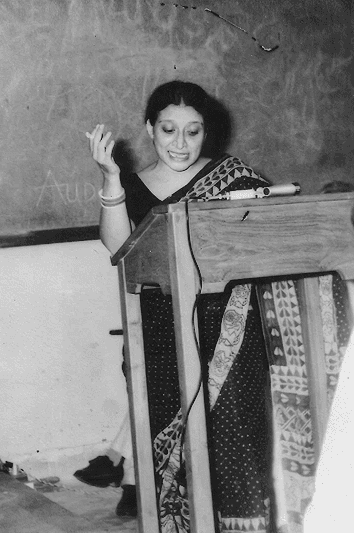
Fahmida Riaz
In the late 1970s, Fahmida Riaz's magazine Awaz became a target under General Zia-ul-Haq. The state accused her of sedition; over ten criminal cases were filed, and she was forced to flee Pakistan with her children. Exile could have silenced her, yet Riaz refused to retreat. Across borders, she continued to write, translate, and speak, insisting that the power of the word could not be confined by prisons, borders, or bans. Her life in India was a testament to the personal cost of dissent, and a vivid demonstration that a woman's voice, even under threat, could shape public imagination and conscience.
March 1973, Rawalpindi: police opened fire on a National Awami Party rally. Amidst the smoke and chaos, Riaz wrote a poem that transformed fear into collective reckoning:
Aao ae hum-watano raqs karo
Raqs karo ghaiz ka raqs
Bikharte hue pindaar ka raqs
Ranj o ruswaai ka umeed-e nigoon-saar ka raqs
Pairahan chaak karo maslihat-andeshi ka
Apne ashkon ki baraste hue bochhaar mein aao
Yeh jhijhakte hue baazu to hawa mein lehraao
Jism ko raqs ke girdab mein chakrane do
Come, O my compatriots, dance
Dance, the dance of rage.
The dance of a shattered pride,
The dance of grief and humiliation,
The dance of a hope bowed low.
Tear open the garment of cautious calculation,
Come into the downpour of your own tears.
Lift these hesitant arms into the air
Let the body spin within the whirlpool of dance.
In a moment when the state sought to silence dissent, her poetry became a space for public courage, demanding that citizens embody resistance and imagination together.
When General Zia-ul-Haq's regime decreed that women must wear a black chadar, Riaz's fiery poem Chadar Aur Chaar Diwaari responded with defiance. Addressing the state directly, her words insist that women's bodies and lives cannot be confined. She invests within the dark shroud multiple meanings, wrestling it back from those seeking to impose it on her and other women:
na sog mein hoon ki us ko odhun
gham-o-alam khalq ko dikhaoon
na rog hoon main ki is ki tarikiyon mein khiffat se doob jaaoon
na main gunahgar hoon na mujrim
ki is siyahi ki mehr apni jabin pe har haal mein lagaaoon
I am not in mourning that I should wear this
To flag my grief to the world
I am not a disease that needs to be drowned in secret darkness
I am not a sinner nor a criminal
That I should stamp my forehead with its darkness
Finally, she overturns the logic of control, it is not she who should be ashamed:
siyah chadar se apne hujre ki bekafan laash dhaanp dijiye
With this black chadar cover the shroudless body lying in your chamber
In 1983, police raided her home in Bombay searching for "subversive" material. In House Raid, Riaz captures the tension of the moment, where the walls of her own house, usually a private refuge, became sites of surveillance and threat:
I hadn't seen my house this way before. I can hear my heart racing in the doors and walls...Now, new essays will be written on the city wall...And so, the root of this fear is just an old book. Pull aside this curtain and look - at the vision of my future.
Even under intimidation, Riaz transforms fear into creative and public possibility, insisting that literature itself is a space of resistance.