Roshan Ara Begum
A Classical Voice in a Changing World
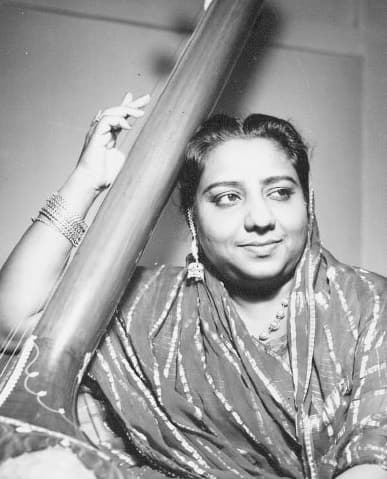
Roshan Ara Begum (c. 1917-1982) was one of the foremost exponents of North Indian classical music in the twentieth century, associated with the Kirana gharana and celebrated across India and, later, Pakistan. Trained from childhood, she performed in elite musical gatherings, she broadcast on All India Radio, and built a reputation for a voice that was at once delicate and expansive. Yet her life, and career, would come to be shaped not only by her artistry, but by the profound political and social transformations of the subcontinent in the mid-twentieth century.
Her story is not simply one of musical achievement. It is a story about what it meant for a woman to sing in public, to move across borders after Partition, and to sustain an art form within tightening regimes of respectability and cultural change.
Respectability and the Female Voice
"Singing wasn't considered a good thing."
Born in Kolkata, she began training at the age of nine under Ustad Laddan Khan, insisting on formal instruction at a time when women's public performance remained morally suspect within many middle-class Muslim contexts.
Soon, a language of legitimacy gathered around her. A Sufi mystic came to the family house one day and asked Roshan Ara to sing. In being deeply moved by her singing, he renamed her Roshan Jahan (light of the world) and foretold of her future fame. Such stories were not incidental. They helped frame her voice as divinely sanctioned, rather than socially transgressive.
By the 1930s and 40s, she had become part of Bombay's vibrant musical culture, performing in mehfils, training within the Kirana tradition, and broadcasting widely. But this early success rested on a fragile balance between talent and acceptability, one that would be unsettled by the upheavals of 1947.
Partition and Displacement: The Collapse of a Musical World
"I told my mother... I would not marry unless my singing would not be affected."
In 1944, she married Chaudhry Ahmed Khan, who had first heard her sing in Bombay. But within a few years, Partition would unravel the world that had made her career possible. Migration to Pakistan meant leaving behind the circuits of patronage, performance, and training that sustained classical music.
In Lalamusa, a small town in Punjab where she resettled after 1947, that loss became immediate. For over a year, she did not sing. There were no accompanists, no established performance spaces, and little of the cosmopolitan culture that had once sustained her practice.
Later, she would temper this account. But she also acknowledged:
"Yes... I was held back for some time."
What had once been a life structured around music was abruptly narrowed by geography, by infrastructure, and by the reordering of cultural life in a new nation-state.
Marriage and Control: Negotiating the Right to Perform
"All my romance and passion were for my music."
If Partition reshaped the external world of music for Roshan Ara, marriage defined its internal limits. Roshan Ara's return to performance was not a simple resumption, but a negotiation. Practice continued at home, and performances resumed gradually through Radio Pakistan and carefully managed appearances in Lahore.
But entry into public space came with conditions. Invitations were vetted. Audiences assessed. In mehfils, her husband often sat in the front row, guiding and monitoring her performance.
Roshan Ara herself narrated this carefully, defending her husband's support, while also acknowledging constraint. This was not a contradiction, but a mode of survival within a system where female performance remained tied to family honor and public respectability.
To sing, under these conditions, required not only mastery, but constant calibration.
Endurance Within Constraint
Roshan Ara Begum would eventually receive national recognition, including the Sitara-e-Imtiaz and the Pride of Performance. Today, she is remembered as one of the great classical vocalists of her generation.
Yet her life resists a simple narrative of success.
It is marked by displacement after Partition, by interruptions in her career, and by the continuous negotiation required of a woman performing within a society structured by norms of respectability. Her voice endured, but always within, and against, the conditions that sought to shape it.
To place her at the center of change is to recognize not only her artistry, but the historical forces that defined its possibilities.
Roshan Ara Begum
Kirana gharana · 2 recordings
Raag Shudh Sarang
Roshan Ara Begum
Roshan Ara Begum (c. 1917-1982) was one of the foremost exponents of North Indian classical music in the twentieth century, associated with the Kirana gharana and celebrated across India and, later, Pakistan. Trained from childhood, she performed in elite musical gatherings, she broadcast on All India Radio, and built a reputation for a voice that was at once delicate and expansive. Yet her life, and career, would come to be shaped not only by her artistry, but by the profound political and social transformations of the subcontinent in the mid-twentieth century.
Her story is not simply one of musical achievement. It is a story about what it meant for a woman to sing in public, to move across borders after Partition, and to sustain an art form within tightening regimes of respectability and cultural change.
"Singing wasn't considered a good thing."
Born in Kolkata, she began training at the age of nine under Ustad Laddan Khan, insisting on formal instruction at a time when women's public performance remained morally suspect within many middle-class Muslim contexts.
Soon, a language of legitimacy gathered around her. A Sufi mystic came to the family house one day and asked Roshan Ara to sing. In being deeply moved by her singing, he renamed her Roshan Jahan (light of the world) and foretold of her future fame. Such stories were not incidental. They helped frame her voice as divinely sanctioned, rather than socially transgressive.
By the 1930s and 40s, she had become part of Bombay's vibrant musical culture, performing in mehfils, training within the Kirana tradition, and broadcasting widely. But this early success rested on a fragile balance between talent and acceptability, one that would be unsettled by the upheavals of 1947.
"I told my mother... I would not marry unless my singing would not be affected."
In 1944, she married Chaudhry Ahmed Khan, who had first heard her sing in Bombay. But within a few years, Partition would unravel the world that had made her career possible. Migration to Pakistan meant leaving behind the circuits of patronage, performance, and training that sustained classical music.
In Lalamusa, a small town in Punjab where she resettled after 1947, that loss became immediate. For over a year, she did not sing. There were no accompanists, no established performance spaces, and little of the cosmopolitan culture that had once sustained her practice.
Later, she would temper this account. But she also acknowledged:
"Yes... I was held back for some time."
What had once been a life structured around music was abruptly narrowed by geography, by infrastructure, and by the reordering of cultural life in a new nation-state.
"All my romance and passion were for my music."
If Partition reshaped the external world of music for Roshan Ara, marriage defined its internal limits. Roshan Ara's return to performance was not a simple resumption, but a negotiation. Practice continued at home, and performances resumed gradually through Radio Pakistan and carefully managed appearances in Lahore.
But entry into public space came with conditions. Invitations were vetted. Audiences assessed. In mehfils, her husband often sat in the front row, guiding and monitoring her performance.
Roshan Ara herself narrated this carefully, defending her husband's support, while also acknowledging constraint. This was not a contradiction, but a mode of survival within a system where female performance remained tied to family honor and public respectability.
To sing, under these conditions, required not only mastery, but constant calibration.
Roshan Ara Begum would eventually receive national recognition, including the Sitara-e-Imtiaz and the Pride of Performance. Today, she is remembered as one of the great classical vocalists of her generation.
Yet her life resists a simple narrative of success.
It is marked by displacement after Partition, by interruptions in her career, and by the continuous negotiation required of a woman performing within a society structured by norms of respectability. Her voice endured, but always within, and against, the conditions that sought to shape it.
To place her at the center of change is to recognize not only her artistry, but the historical forces that defined its possibilities.